
I'm Looking for...
Evidence Based Research To fulfill our commitment to bringing our audience accurate and insightful content, our expert writers and medical reviewers rely on carefully curated research.
Read Our Editorial Policy
From the first recognition of type 1 diabetes as an immune-mediated condition in the 1970s, it has remained a life-altering disease with no cure, impacting more than 9 million people worldwide—many who are diagnosed in young childhood or adolescence.
Now, a first-of-its-kind drug called teplizumab has gained Food and Drug Administration (FDA) approval for slowing the progression of type 1 diabetes in people at high risk. It represents a major shift in how we may be able to delay—or possibly even prevent—the full onset of the disease that requires daily and lifelong insulin.
But is it actually a type 1 diabetes cure, or simply delaying the inevitable? Here’s a closer look at the research behind teplizumab: how it works, what it can (and can’t) do, and whether a functional cure for type 1 diabetes may finally be on the horizon.
Unlike type 2 diabetes, type 1 diabetes is an autoimmune disease, meaning the body’s immune system mistakenly attacks its own cells—in this case, it attacks insulin-producing beta cells in the pancreas.
As beta cells are destroyed, insulin levels drop. Without enough insulin, the body can’t shuttle glucose from the bloodstream into cells for energy, which leads to dangerously high blood sugar.
While type 2 diabetes is heavily influenced by lifestyle factors like diet, exercise, and weight, type 1 diabetes often develops suddenly—most commonly in children and teens, although it can affect people of all ages.
Researchers now understand that this autoimmune destruction happens gradually over time, and they categorize type 1 diabetes into three stages:
Once most of the beta-cells are gone (Stage 3), the body can no longer make the necessary insulin to survive. At that point, people need to be on lifelong insulin.
But it’s not just as simple as one injection a day—living with type 1 diabetes requires continual blood sugar monitoring, careful carbohydrate intake, and lots of problem-solving to prevent spikes or drops in blood glucose.
That’s why a drug that could slow or even prevent the destruction of beta cells would be such a monumental breakthrough.
Teplizumab (brand name Tzield) is an FDA-approved medication called a “monoclonal antibody”—a lab-made protein designed to target specific immune cells.
Rather than broadly suppressing the immune system, teplizumab binds to a protein (CD3) on the surface of many T cells.
This interaction alters the behavior of those T cells: dampening their aggression, reducing the activity of destructive immune cells, and boosting regulatory T cells that help protect the pancreas. In effect, it helps slow the immune attack on beta cells and preserves insulin production for longer.
Essentially, the goal isn’t to entirely cure the disease (at least, not yet), but to slow the progression into Stage 3—the stage where symptoms are present, and insulin therapy is needed.
In other words, teplizumab buys time for the pancreas, which could mean a dramatically different future for someone on the verge of developing type 1 diabetes.
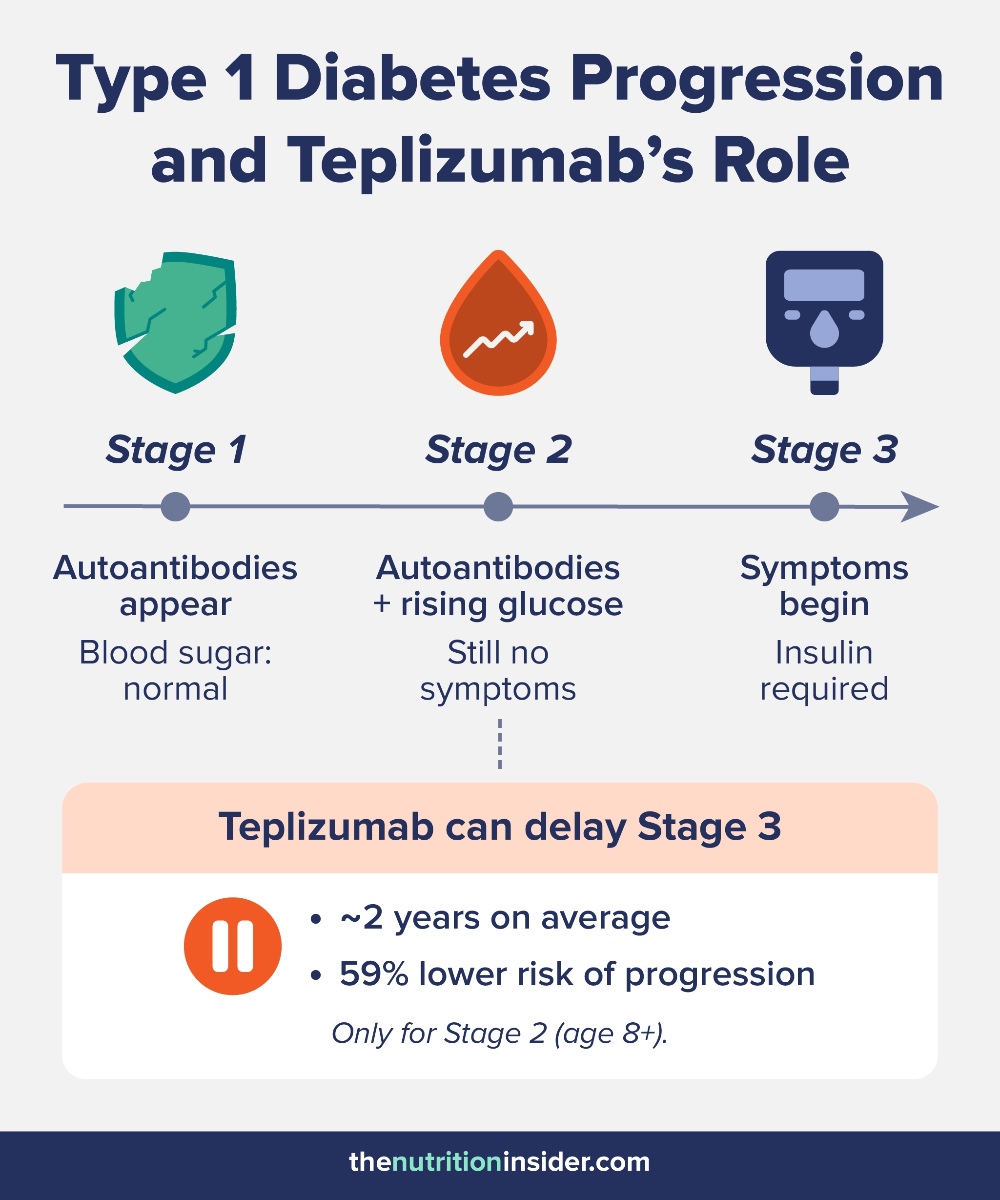
Teplizumab is backed by clinical trials showing it can significantly delay the onset of type 1 diabetes in people who are already in the early stages of the disease.
In one major trial published in The New England Journal of Medicine, participants at high risk of developing type 1 diabetes received a 14-day course of teplizumab. The results were impressive, finding:
In a long-term follow-up with the same group, more than one-third of patients treated with teplizumab had still not progressed to Stage 3 after five years. And according to the research team, some participants from the first trial—which began in 2011—still have not developed type 1 diabetes.
While teplizumab doesn’t prevent type 1 diabetes in all cases (no drug will), preserving insulin production for even a few more years—especially during childhood and adolescence—can make daily management much easier and reduce long-term health risks.
For a teen, delaying intensive insulin therapy from age 15 to age 20, for example, could mean a completely different experience navigating school, sports, social activities, and independence.
Delaying the progression of type 1 diabetes isn’t just about postponing insulin—it can change the day-to-day reality of managing blood sugar.
When the pancreas is still making some insulin, even in small amounts, the body is better able to:
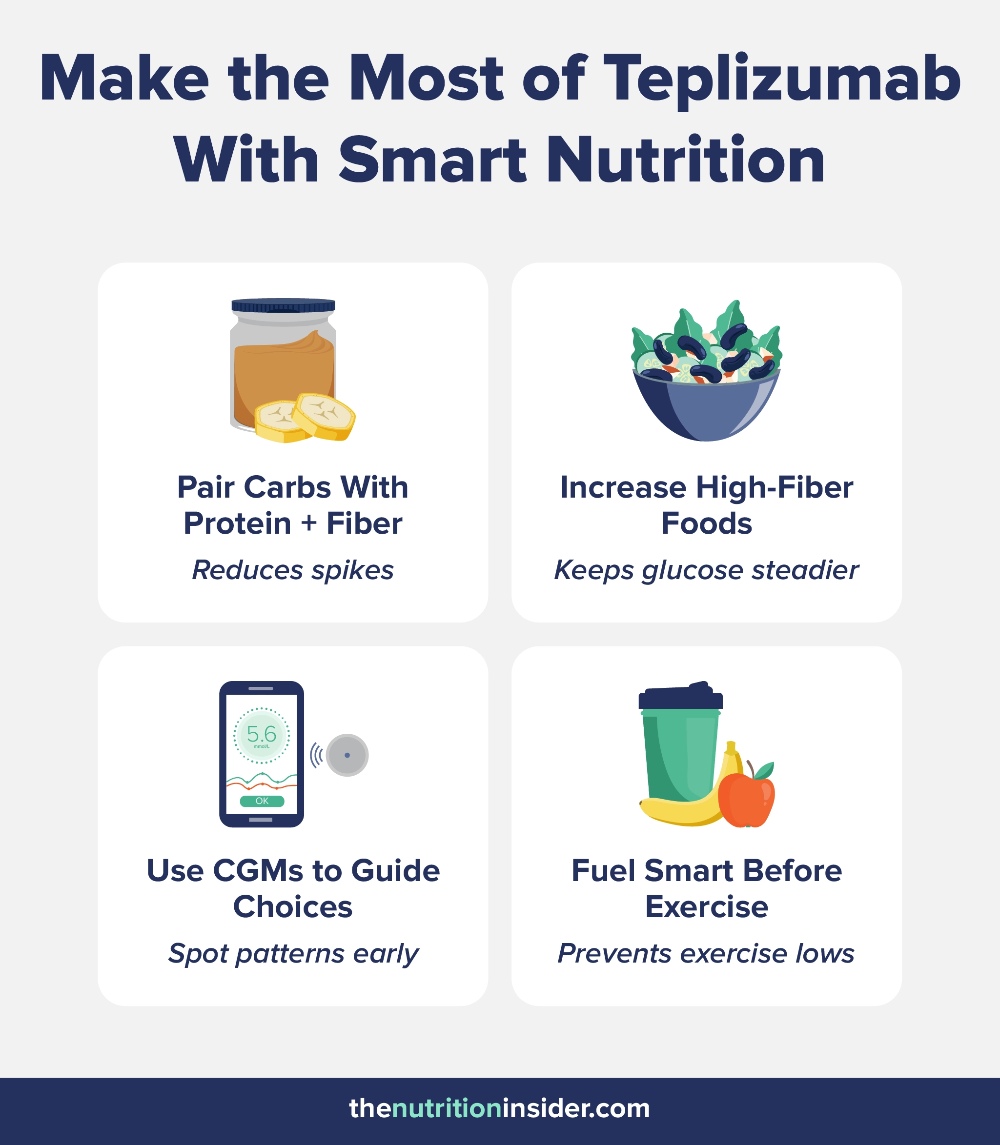
Because insulin production declines gradually, nutrition becomes even more important during this window.
Smart strategies like pairing carbohydrates with protein and fiber, optimizing pre-exercise fueling, increasing dietary fiber, and using continuous glucose monitors (CGMs) to guide decisions can help people stay in a healthy glucose range longer with less effort and stress.
Even a few extra years of steadier blood sugar during childhood and adolescence may help protect against complications later in life, while supporting normal growth, energy, and development.
Teplizumab is currently FDA-approved for people age 8 and older who have “Stage 2” type 1 diabetes, meaning they test positive for at least two pancreatic autoantibodies and show abnormal blood-glucose regulation, but do not yet require insulin.
That typically means someone with:
Because most people don’t know they’re in Stage 2, screening is a crucial first step. For example, TrialNet—a large national screening program—offers free risk screening for relatives of people with type 1 diabetes.
That said, people already diagnosed with symptomatic, insulin-dependent type 1 diabetes (Stage 3) are not eligible, as teplizumab is approved only for delayed-onset, not for reversing established disease.
Like most medications, there are some downsides to teplizumab that are important to understand.
While it can significantly delay the onset of type 1 diabetes, it doesn’t prevent the condition in everyone, and many treated individuals will still eventually require insulin therapy.
Timing is also critical. Teplizumab only works for people identified in the early autoimmune stages (Stage 2). Once someone is already symptomatic and insulin-dependent, the drug is no longer helpful.
Other limitations include:
These challenges make broader screening and improved access essential if teplizumab is going to reach the people who could benefit from it most.
Teplizumab isn’t a type 1 diabetes “cure” in the true sense of the word—but it can dramatically improve quality of life by delaying someone’s progression into Stage 3, when constant insulin therapy becomes necessary.
For the first time, a treatment can change the timeline of type 1 diabetes.
By preserving remaining beta cells and postponing the point where the pancreas stops making insulin, teplizumab gives people more years with less intensive disease management, which can be monumental for children and teens navigating this condition.
Experts believe that a true cure for type 1 diabetes will likely require multiple approaches working together: immune therapies like teplizumab, treatments that restore or protect beta cells, and continued progress in diabetes technology.
For example, an experimental therapy called Zimislecel (VX-880) aims to restore insulin production using lab-grown islet cells. Early results are hopeful, but it remains under study and will require more evidence before it becomes a widely available option.
So while teplizumab may not halt type 1 diabetes forever, it represents a major and hopeful step toward a future where the disease is no longer inevitable.
While these medical advancements are exciting, they don’t replace the daily decisions that impact blood sugar. A Registered Dietitian (RD) plays a critical role in helping people at risk for type 1 diabetes—and families navigating early-stage disease—feel confident and supported.
Working with an RD can help you:
If you or someone you love is at increased risk for type 1 diabetes or has been newly diagnosed, you don’t have to go through it alone.
Our RDNs specialize in personalized nutrition support, including for people navigating type 1 diabetes—schedule a consultation today.
Haelle, T. A Cure for Type 1 Diabetes Seems Close, Thanks to New Drugs and Tech. Scientific American. October 14, 2025. https://www.scientificamerican.com/article/a-cure-for-type-1-diabetes-may-be-closer-than-you-think/
Herold KC, Bundy BN, Long SA, et al. An Anti-CD3 Antibody, Teplizumab, in Relatives at Risk for Type 1 Diabetes. N Engl J Med. 2019;381(7):603-613. doi:10.1056/NEJMoa1902226
Keam SJ. Teplizumab: First Approval. Drugs. 2023;83(5):439-445. doi:10.1007/s40265-023-01847-y
Lledó-Delgado A, Preston-Hurlburt P, Currie S, et al. Teplizumab induces persistent changes in the antigen-specific repertoire in individuals at risk for type 1 diabetes. J Clin Invest. 2024;134(18):e177492. Published 2024 Aug 13. doi:10.1172/JCI177492

We’re always looking for a new breakfast to add into our rotation and this healthy chocolate coffee smoothie is our new star player!
Read More
These “apple donuts” make for a great post-meal sweet treat or midday pick-me-up. You only need a few very simple ingredients and amateur cutting skills to get these things done and ready in five minutes!
Read More